
Design Thinking in Schools: A Blueprint for Future Innovators
Design thinking in schools is a way of teaching children to solve real problems by first understanding the people behind them. Students learn to listen, ask better questions, come up with many possible answers, build rough versions of their ideas, and improve those ideas based on feedback. It began at Stanford’s d.school and was popularised in classrooms by the design firm IDEO, and today it sits at the heart of how the best international schools teach.
The World Economic Forum’s Future of Jobs Report 2025 puts creative thinking and analytical reasoning at the top of the skills employers will chase through 2030. Schools everywhere are paying attention. Those already running inquiry-based models, particularly IB PYP and Cambridge, have had a head start in folding design thinking into daily classrooms.
This guide walks you through what design thinking in schools actually looks like for children growing up right now, the five stages your child will learn, real classroom stories, and a few simple things you can do at home to support the same mindset.
What Is Design Thinking in Schools?
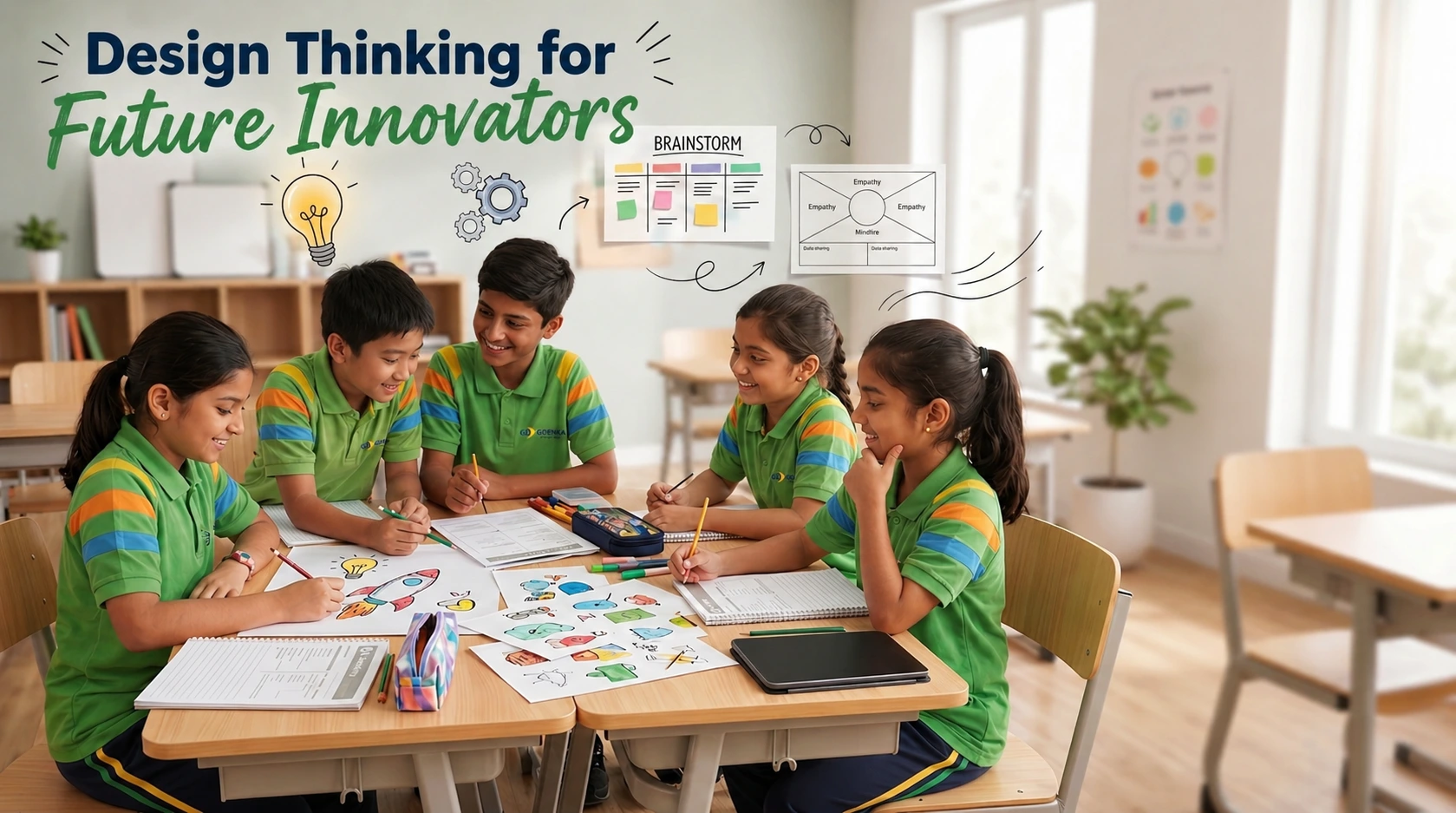
Design thinking in schools is an inquiry-led approach where students work through five rough stages: empathise, define, ideate, prototype, and test. They are not meant to follow these stages in a straight line. Students loop back, change their minds, throw out ideas, and try again. That looping is the whole point.
Rote learning trains children to find the one right answer. Design thinking does something different. It teaches them that most real problems have many possible answers, and that the good ones usually show up only after the first few obvious ones have been tried and rejected.
IDEO, the firm that brought this approach into schools, describes it as a framework that helps young people handle complexity and uncertainty. That phrase sounds simple, but it is doing a lot of work. A child who can sit with uncertainty without panicking, and who knows what to do next when the first idea fails, has already learned something most adults are still figuring out.
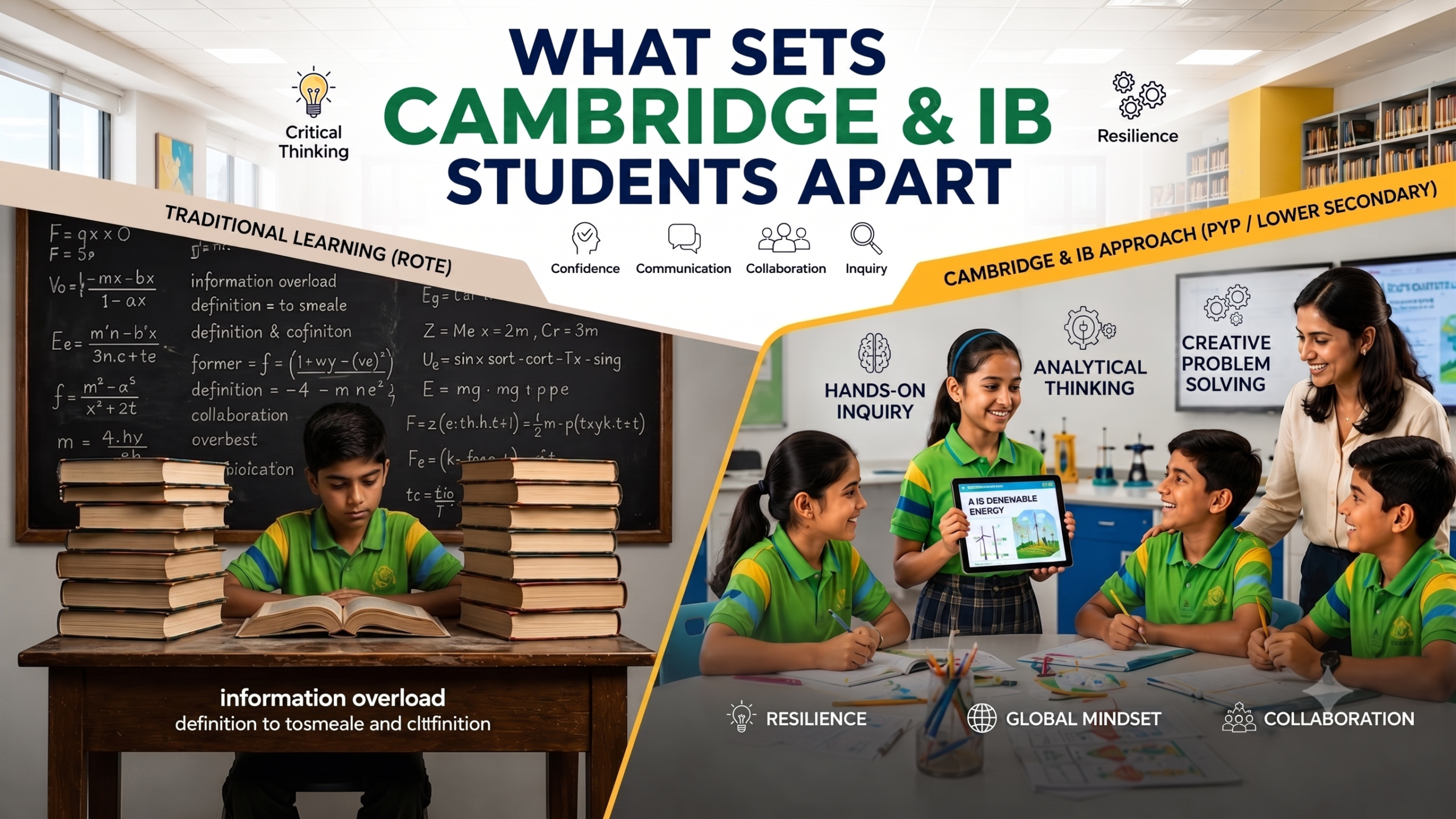
How Design Thinking Differs From Traditional Learning
|
Traditional Learning |
Design Thinking Approach |
|
Teacher-led instruction |
Student-led inquiry |
|
One correct answer |
Multiple valid solutions |
|
Memorise and recall |
Empathise, ideate, iterate |
|
Individual performance |
Collaborative problem-solving |
|
Failure is avoided |
Failure is data for improvement |
|
Subject silos |
Interdisciplinary challenges |
Why Design Thinking Matters in Education Today
Three things have shifted, and together they explain why design thinking in education has moved from optional to essential.
1. The Skills Employers Want Have Changed
According to the WEF’s Future of Jobs Report, around 39% of the skills workers rely on will be different by 2030. The ones climbing fastest are creative thinking, resilience, flexibility, and analytical thinking. These are exactly the muscles a design-thinking classroom builds every week.
2. AI Has Changed What Humans Are Good For
When generative AI can do routine cognitive work in seconds, the things that still belong to humans become more valuable, not less. Empathy. Ethical judgement. The ability to connect dots no one else has connected yet. Harvard’s Graduate School of Education found that children trained in design thinking were noticeably more willing to take on ambiguous problems and trust their own creative instincts. That willingness is now a career advantage.
3. The Big Problems Don’t Fit Neat Subject Boxes
Climate change, urban housing, public health after a pandemic — none of these sit inside just one subject. Students who only know how to think like a scientist or only like a historian will struggle. Design thinking deliberately asks children to pull from several subjects at once, which is how real innovation actually happens outside school.
The 5 Stages of Design Thinking for Students
Stanford’s d.school laid out the five stages that make up design thinking for students. In a good classroom, children move through them loosely, not rigidly, and the complexity grows with the grade.
Stage 1: Empathise
Students start by trying to understand the people affected by the problem. They watch, they ask, they listen. A Grade 3 child might spend a morning sitting with the canteen staff, watching how younger children struggle at lunch. Before any solution is proposed, the problem has to be felt.
Core skill: Perspective-taking and active listening.
Stage 2: Define
Once they have enough information, students learn to turn it into a clear problem statement. Instead of a vague goal like “make lunch better,” a class might land on something tighter: How might we help Kindergarteners feel less overwhelmed at lunch so they actually eat their food? That shift from vague to specific is where good solutions start.
Core skill: Problem framing and synthesis.
Stage 3: Ideate
Now the ideas come out. Lots of them. Good classrooms teach children to hold back judgement during this stage. Crazy-eights sketching, “yes, and…” prompts, mind-maps on chart paper — the goal is quantity over quality. The weird ideas often lead to the strong ones.
Core skill: Divergent thinking and creative fluency.
Stage 4: Prototype
This is where ideas leave the brain and enter the world. A cardboard model. A quick sketch. A role-play where one student acts out the solution while another plays the user. Prototypes are meant to be rough. Spending three days polishing a first version kills the point.
Core skill: Making ideas tangible and iterating quickly.
Stage 5: Test
Students show their prototype to real users and ask for honest reactions. Often the feedback is hard to hear. A Grade 4 designer who was sure her idea was brilliant learns that users found it confusing. That moment is uncomfortable and also the whole education is too. Failure becomes information, not a verdict.
Core skill: Receiving feedback and iterating.
How Top Schools Integrate Design Thinking Into the Curriculum
The best international schools do not treat design thinking as a separate class on the timetable. They weave it into how everything else is taught.
Design Thinking in the IB Primary Years Programme (PYP)
The IB PYP is built around inquiry, which makes it a natural home for design thinking. Transdisciplinary units like How we organise ourselves or Sharing the planet give students open-ended, real-world problems to sit with. At GDGGS, PYP learners from Nursery through Grade 5 regularly run design challenges that pull together science, social studies, art, and language in a single project.
Design Thinking in the Cambridge Lower Secondary Programme
Cambridge Assessment International Education describes its ideal learner as confident, responsible, reflective, innovative, and engaged. Read that list carefully and you will notice every single attribute is something design thinking in schools directly builds. For Grades 6 to 8, this shows up as STEAM projects, enterprise briefs, and community-impact challenges where students apply what they are learning to problems that matter.
Design Thinking in Everyday Classroom Practice
- Maker-spaces and innovation labs where students can actually build what they imagine
- Project-based learning units that run across two to six weeks, not a single period
- Community-linked briefs sourced from parents, local NGOs, or problems inside the school itself
- Reflective journals where students track how their thinking changed between the first and final version
Real Classroom Examples of Design Thinking
Frameworks are easier to believe once you see them working with actual children. Here are three scenarios, across age groups, that show design thinking for kids and older students in practice.
Example 1: Grade 2 and the Lonely Bench
A group of seven-year-olds noticed that one classmate kept sitting alone at break. Instead of just being told to include him, they interviewed classmates about what made joining a group feel hard. They framed the question: How might we help everyone find someone to play with? They brainstormed over thirty ideas. One stuck — a painted “Buddy Bench” where anyone looking for a play partner could sit, and others would know to invite them over. They built a cardboard prototype, tested it, and eventually the school installed a permanent version. A real problem, solved by children.
Example 2: Grade 5 Tackling Lunch Waste
A PYP unit on sustainability turned into a two-week waste audit. Students weighed leftover food, interviewed the kitchen team, and discovered younger children were being served more than they could eat. They designed a visual “portion chooser” that let Kindergarteners show how hungry they were before serving. Canteen waste dropped by 22% over one term.
Benefits of Design Thinking for Students
Research and classroom experience point in the same direction. Students who regularly go through design thinking for students projects show real gains, and not in one area, but several.
- Creative confidence: A Stanford d.school study found students trained in design thinking rated their own creative ability around 45% higher than peers in traditional classrooms.
- Collaboration skills: Almost every project is team-based, which teaches children to disagree without breaking the team and to build on someone else’s half-idea.
- Resilience and growth mindset: When failure becomes a normal part of the process, children stop fearing it. That single shift changes everything about how they learn.
- Empathy and emotional intelligence: Regular user-research makes it a habit to ask what someone else is feeling before deciding what to do.
- Higher-order thinking: Analysis, synthesis, evaluation — these are the top rungs of Bloom’s Taxonomy, and design thinking lives on them.
- Transfer of learning: Because projects cut across subjects, knowledge sticks. Children remember what skills they have used, not what they have memorised for a test.
How Parents Can Support Design Thinking at Home
Design thinking is not just a school thing. It is a way of thinking, and you can quietly reinforce it at home without any special tools, apps, or kits. The changes are small.
- Ask “how might we” questions. When something annoys your child — a messy cupboard, a boring Saturday afternoon, a toy that keeps breaking — reframe it as a design challenge. The phrase itself teaches them something.
- Delay your answers. When your child asks a question, try resisting the urge to solve it. Ask what they think first. Ideation is a muscle, and you are either exercising it or you are doing the reps for it.
- Praise prototypes. Celebrate the messy first version. The cardboard spaceship. The half-built Lego thing. The first draft of a story that makes no sense. Finished work gets too much attention. Early drafts deserve more.
- Change how you talk about failure. Swap “it didn’t work” for “what do we do differently next time?” Same situation, entirely different message.
- Practise empathy at the dinner table. Ask regularly whose day was harder than yours today, and why. Empathy is a habit, and habits need repetition.
Design Thinking at GD Goenka Global School
At GD Goenka Global School, design thinking is not a module we added on. It is built into how our students learn from Pre-Nursery through Grade 8. Our IB PYP inquiry-based framework gives younger children their first taste of empathy-led exploration. Our Cambridge Lower Secondary Programme then takes that foundation and expands it into the kind of deeper, interdisciplinary work that students in Grades 6 to 8 are ready for.
Across our academic spaces, students move between maker zones, collaborative studios, and community briefs. The result, over time, is the kind of globally-minded, self-starting learner the next decade will ask for.
Frequently Asked Questions About Design Thinking in Schools
What is design thinking in simple words for kids?
Design thinking for kids is a way of solving problems by first understanding how other people feel, then coming up with lots of possible ideas, making rough versions of the best ones, and testing them to see what actually works.
At what age can children start learning design thinking?
Children can begin practising the core habits of design thinking — empathy, curiosity, and experimentation — from around age three. Full five-stage projects usually start from Grade 1 onwards, and the complexity deepens with each year.
Is design thinking the same as STEM or STEAM?
No. STEM and STEAM describe the subjects that are being integrated. Design thinking describes the approach students use regardless of subject. They work well together, but they are not the same thing.
How is design thinking assessed in schools?
Teachers assess the process, not just the outcome. Growth is tracked across empathy, ideation, prototyping, iteration, and reflection, usually through rubrics, process portfolios, and student self-assessments.
Which curricula place the most emphasis on design thinking?
The IB Primary Years Programme (PYP), IB Middle Years Programme (MYP), and Cambridge International Curriculum explicitly build inquiry and design-led learning into their frameworks. While CBSE has started introducing these elements through NEP 2020’s Art Integrated Learning, and experiential learning; international curricula are still far ahead in terms of depth for design thinking curriculum integration.
Is design thinking something that one can teach online or only in the classroom?
Design thinking can absolutely work online. It is a way of thinking, not a physical setup. That said, in-person classrooms make prototyping faster, peer feedback richer, and empathy-building more natural through face-to-face interviews.
Does design thinking improve academic performance?
Work from Stanford’s d.school and Harvard’s Project Zero suggests students in design-thinking classrooms show measurable gains in critical thinking, collaboration, and subject retention. The reason is simple: when children apply knowledge to real problems, they remember it far better than when they only revise it for a test.
Final Thoughts
The children sitting in our classrooms today will enter a working world where empathy, reframing, and iteration will matter more than any single piece of content they memorised. Design thinking in schools is not a fashionable trend. It is the underlying mindset that makes every other skill, from coding to communication, actually useful.
Schools that take design thinking seriously are not preparing students for a test. They are preparing them for the kind of world that is already showing up.
To see how GD Goenka Global School integrates design thinking across our IB PYP and Cambridge Lower Secondary programmes, explore our admissions process or book a campus visit.